DARPA MAGICS: Methodological Advancements for Generalizable Insights into Complex Systems
MAGICS seeks to catalyze paradigm-shifting approaches for understanding and predicting collective human behavior in complex, dynamic, and non-ergodic systems. It explicitly addresses the limitations of prevailing data-driven and statistical methods, emphasizing the need for new theoretical frameworks, metrics, and methodologies that can rigorously characterize the boundaries of inference, alignment between latent constructs and observables, and model adaptation over time. The ARC encourages integrative work spanning computational science, behavioral science, psychometrics, and machine learning, with a strong focus on validation against real-world, open-world data rather than simplified or simulated settings. By foregrounding generalizability, methodological rigor, and forward-looking validation, MAGICS aims to advance the scientific foundations required for reliable prediction and explanation in evolving sociotechnical systems.
DARPA ITM: In the Moment
The ITM program advances the scientific foundations required to build and field trusted algorithmic decision-makers in difficult operational domains where no single “correct” answer exists, such as combat medical triage. My work focused on Technical Area 2 (TA2): Human-aligned algorithmic decision-makers, which develops computational methods for constructing decision systems that explicitly align with the decision-making attributes of trusted human experts. TA2 research leverages quantitative alignment scores and decision-maker characterizations to ensure that algorithmic decisions reflect human values, preferences, and contextual sensitivities for both individual and grouped decision-makers. By enabling algorithms to adapt their behavior to human attributes rather than fixed objective functions, my work established a principled basis for trust, delegation, and human-off-the-loop autonomy in high-stakes, time-pressured environments.
DARPA SCEPTER: Strategic Chaos Engine for Planning, Tactics, Experimentation, and Resiliency
DARPA SCEPTER focused on developing computational approaches for machine-generated operational planning in highly complex, adversarial environments. The effort centered on methods for representing and reasoning over large state–action spaces, enabling autonomous systems to explore, generate, and evaluate novel courses of action that go beyond human-curated plans. A key emphasis was on unscripted, goal-oriented agents and abstraction strategies that support rapid exploration while preserving interpretability and expert relevance, allowing machine-generated strategies to be meaningfully assessed by human planners. Overall, the work contributed to advancing algorithmic planning systems that can reason at campaign scale, stress-test assumptions through simulation, and improve resiliency by uncovering unexpected but plausible strategic alternatives.
Hybrid Event Memory System (HEMS)
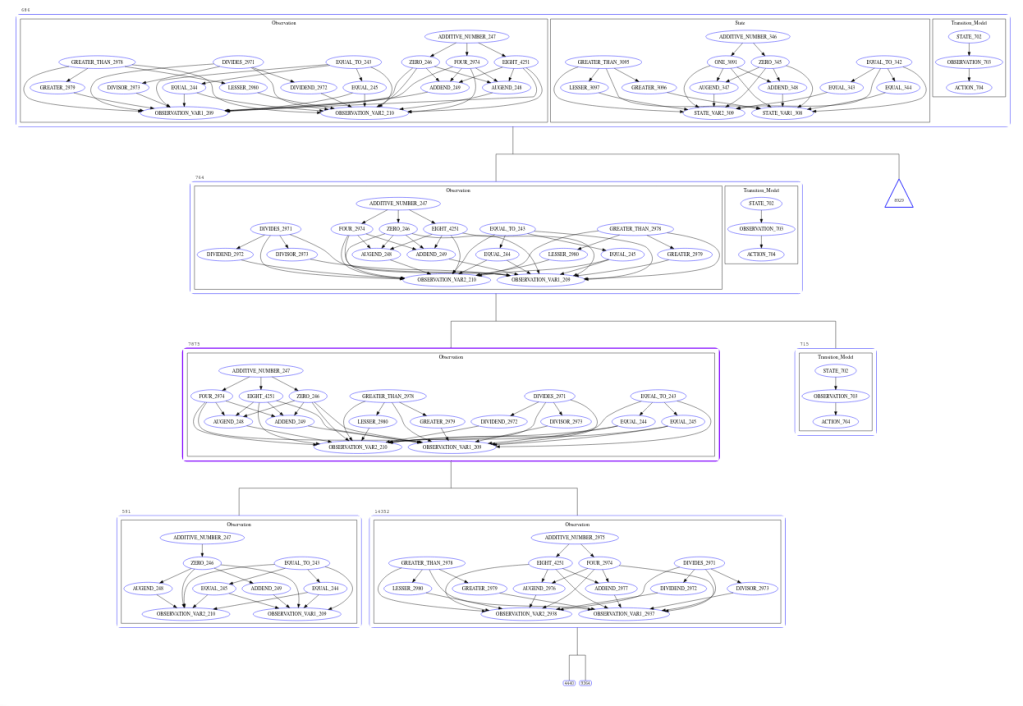
HEMS is a Common Lisp implementation of the Hybrid Theory of Event Memory. It is a computational framework designed to support event cognition in intelligent agents by clustering and classifying structured observations in an event hierarchy. HEMS stores observations as directed acyclic graphs at the lowest levels of the hierarchical event memory and incrementally learns generalizations to form a probabilistic taxonomy of events, enabling online adaptation and improved predictive accuracy as new data are encountered. The system embodies a hybrid theory of event memory that integrates exemplar-based and schema-based perspectives, with mechanisms for efficient rule-based representation of probability distributions. HEMS has been used to model a wide range of event memory phenomena, including remembering, misremembering, and confabulation and facilitates the construction of event memory–enabled intelligent agents that reason temporally under uncertainty, make inferences based on past experience, and produce causal explanations.
Cognitive Architecture/ICARUS
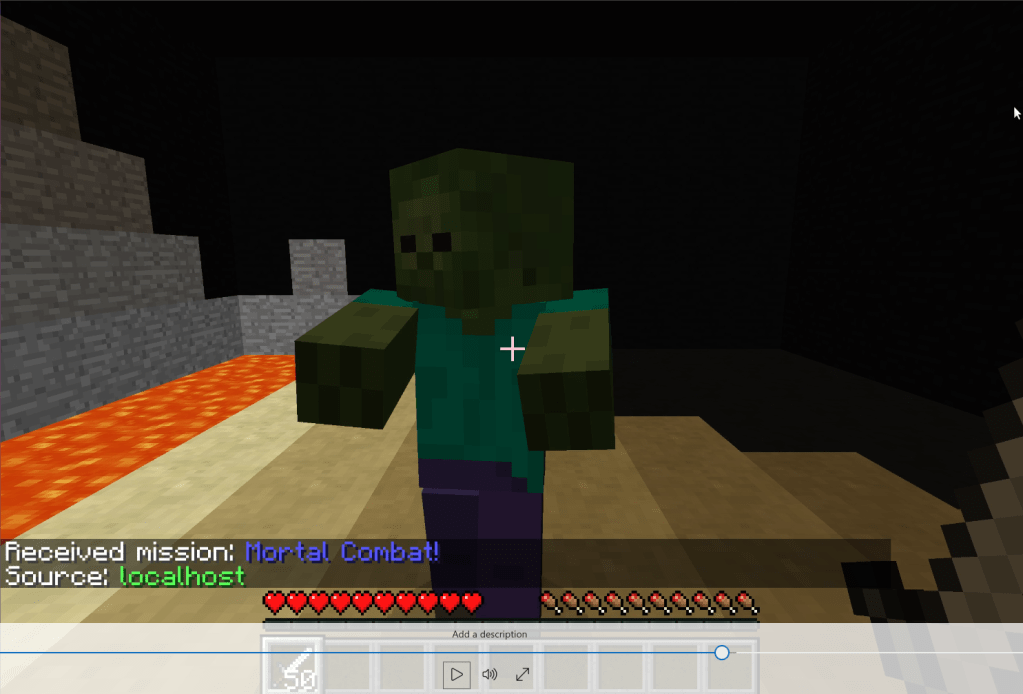
A cognitive architecture specifies the representational structures and computational mechanisms that underlie intelligent behavior, providing an integrated theory of how perception, memory, learning, and action interact over time. The ICARUS cognitive architecture is distinguished by its strong commitment to symbolic, structured representations of knowledge, particularly hierarchical concepts and skills that directly support goal-directed behavior. ICARUS tightly couples learning with execution. The same conceptual and procedural knowledge used for acting is incrementally acquired from experience, enabling continuous refinement rather than offline retraining. Its emphasis on explanatory, human-interpretable knowledge, explicit representations of goals and plans, along with deductive inference rules, problem-solving strategies, and skill execution procedures make ICARUS especially well suited for modeling human cognition and for building agents that must reason, adapt, and explain their behavior in complex environments.
 David Menager